
1 Year Anniversary Dungeon!
A one-page dungeon to celebrate one year on Substack.

Here we are, on the 1-year anniversary of Curious Figures! I started this Substack as a writing outlet. Well, I started it as an excuse to play with my action figures, mostly—but in order to have something to actually say about them, I wanted to consider how these figures might serve as prompts for fiction and TRPG writing.
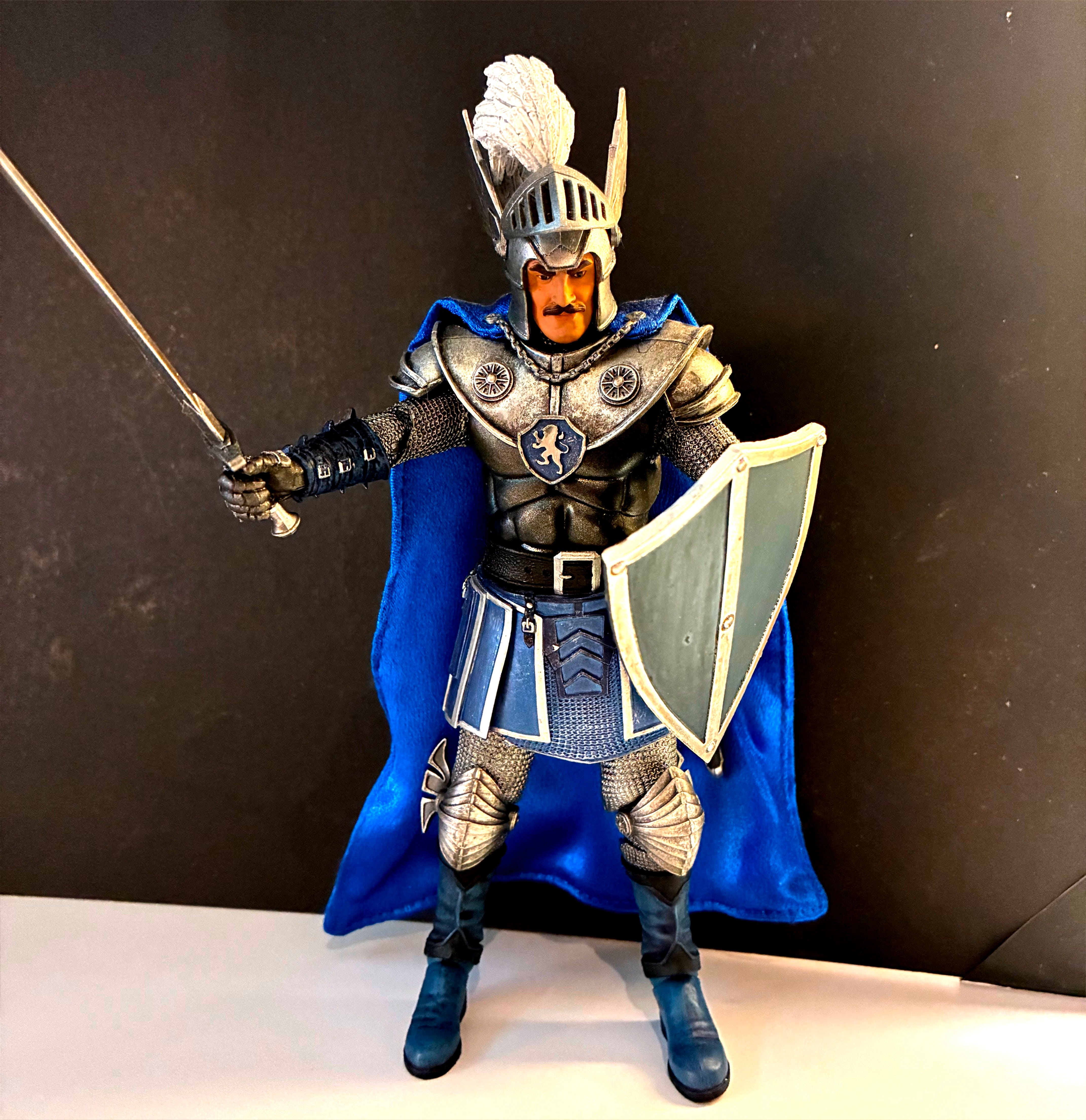
As Daniel Tiger sings, you should try new foods because they might taste good. (Well, gooo-oood, but it’s hard to spell out the extended rising/falling of that word.)
I have more books on my shelf than I’ll ever get around to reading (we all do). And that’s fine, I chose to maybe read them someday, and it still supports the authors. Likewise, I keep a list of movies and shows, some of which I’ll get around to watching. Same with Instagram stories of workouts and drawing exercises.
And you know what… I’ve always wanted to participate in the One-Page Dungeon Contest, as well.
The One-Page Dungeon
If you’re not familiar with it, you can find the contest at dungeoncontest.com.
It’s been running for years now, starting in 2009 (by ChattyDM, now run by Spiel Knights). Essentially, you’re asked to create a TRPG adventure scenario contained to a single page—which is a fantastic exercise, and challenging in its own right.
Thankfully, there’s plenty of great support, resources, and examples available.
When I worked on the D&D website, I remember thinking it would’ve made an excellent venues for one-page dungeons. We offered short scenarios (including many one-shots), but largely avoided a one-page approach; in part, so not to compete with the contest already doing its thing—and doing a hell of a great job with it. I always envied their work!
By confining the “dungeon” (or adventure scenario) to one page, it makes for a good exercise in conciseness. What’s essential to include? What isn’t? At the same time, this has the added benefit of making things system neutral. Since there’s isn’t space for rule mechanics, keep things general for use in any game.
Tools of the Trade
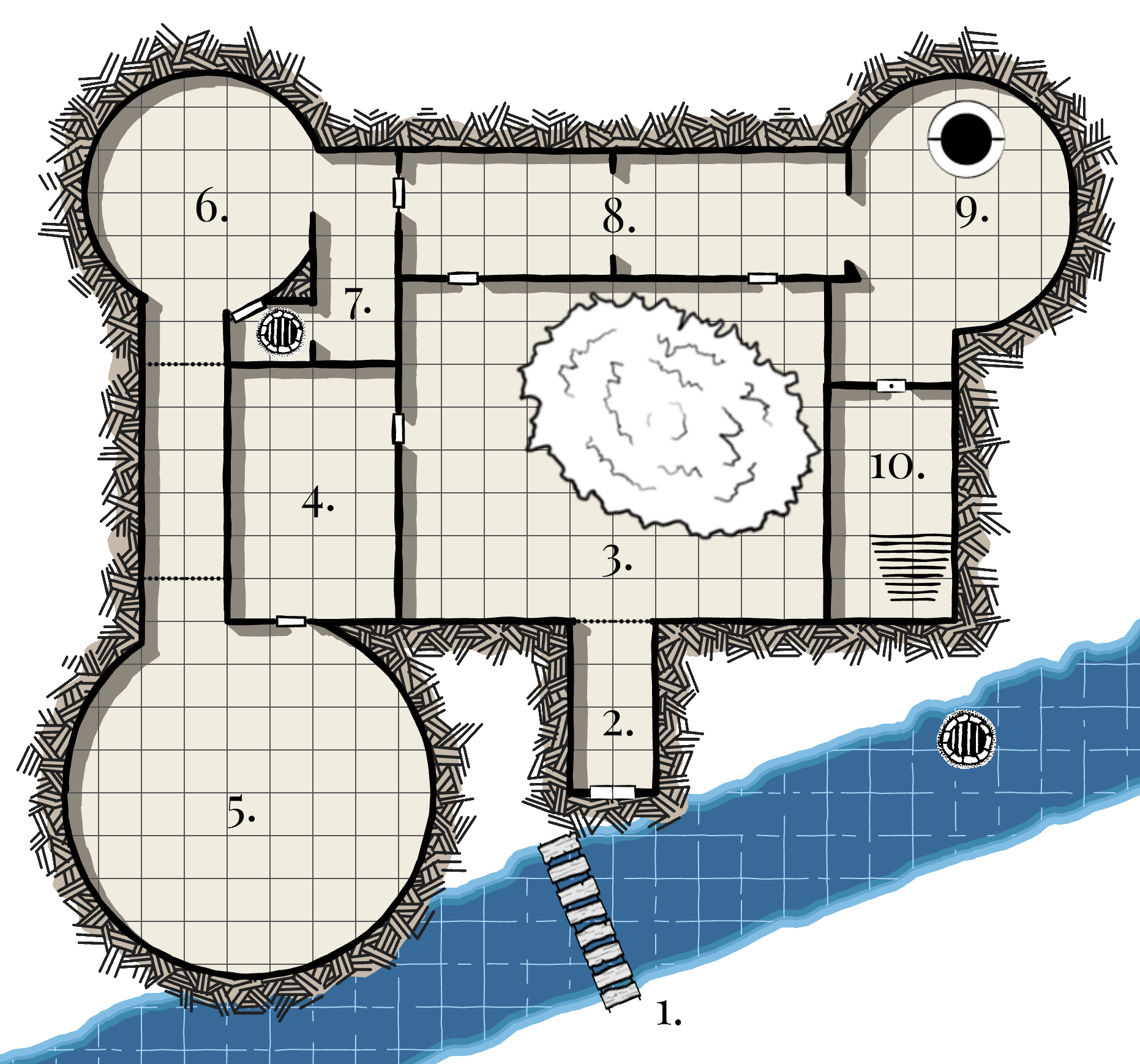
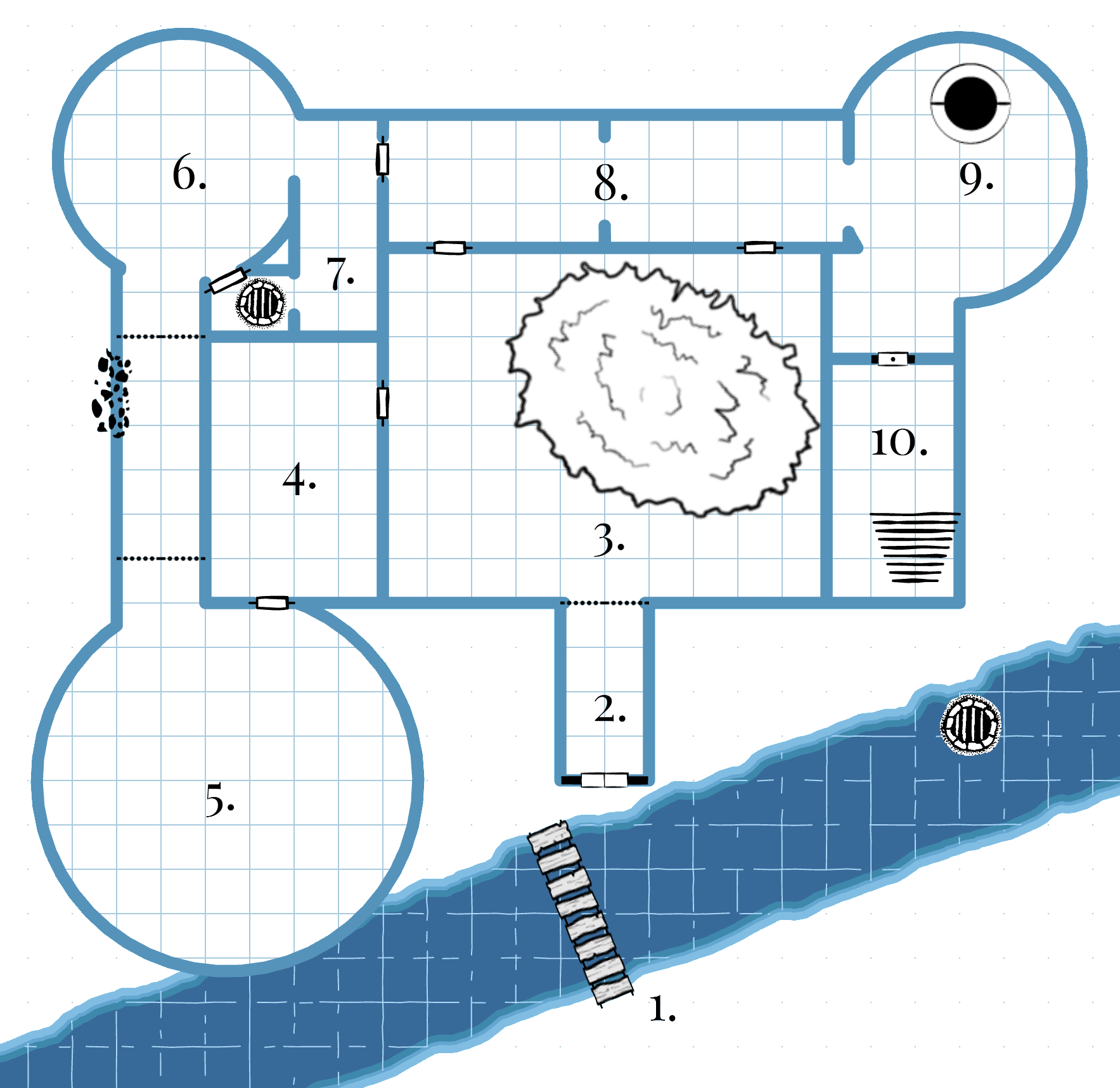
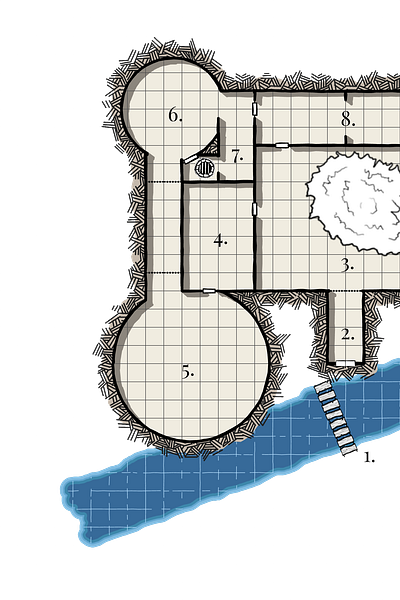
Cartography: For the map, I’m trying out Dungeon Scrawl. There’s a free version, along with paid upgrades. It works well, from the little I’ve played around with it so far; I have some feedback when it comes to moving rooms (I find the Select Tool not as intuitive for this as I’d hoped), but overall it’s a fairly great piece of cartography.
Plus, you can create your map with various cross-hatching options:
Or my beloved old school non-repro blue:
Page Templates: As far as ready-to-use templates, you can find the “classic” template on the One-Page Dungeon site. But there are many, many others. The version I’m trying out can be found at: hlashbrooke.itch.io.
Room Descriptions
Given that you have to fit everything on one page, it is an exercise in brevity. After working within these constraints myself, a few thoughts:
Choose descriptive room names: Every word counts, so use the room name as part of its description. If it’s already named a Ransacked Storeroom, for example, you needn’t describe it any further, just jump straight into its contents.
Give rooms a logical function: A bedroom, a kitchen, an armory. It’s not a “funhouse” style dungeon, like White Plume Mountain, where every room is a puzzle unto itself. It’s a castle, so rooms should be readily identifiable to the players. Conversely, you don’t need to recreate a fully functional castle (hey, where are the bathrooms in this place?), but it helps to have some grounding.
Make small details memorable: If descriptions are necessarily brief, are there small elements to help add a bit of flourish? Not that every detail needs to be a clue or, conversely, a red herring; but what makes an old, abandoned kitchen stand out from every other old, abandoned kitchen—an oven filled with 100 mice? Ancient battlefield weaponry used for utensils? An old recipe for magical scones?
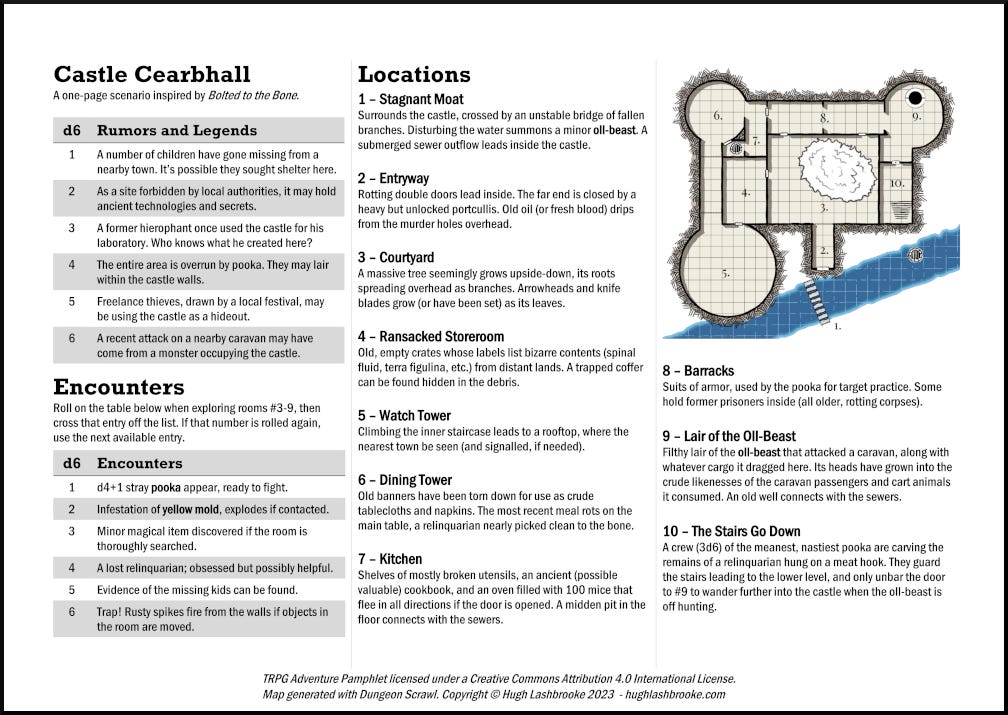
Castle Cearbhall
I created my sample one-page dungeon around a location in Bolted to the Bone. Some of the terms come from the book’s world-building as well. Again, with no room to elaborate on the page, I’ll do so here:
Terminology
In the book, Castle Cearbhall is called a “relinquary site”—a surviving piece of Shattered Earth. I made up relinquary as some portmanteau word of relic, relinquish, and derelict. Reliquaries are containers for saints’ bones. So relinquary sites are pieces of an older world, guarded by the saints.
Likewise, a relinquarian is an explorer, from someplace outside of Shattered Earth (in this case, one of the Rhiannon city-states on the Moon). A relinquarian explorers relinquary sites hoping to find surviving artifacts.
A hierophant is an actual word, for a type of religious figure who reveals and interprets mysteries sacred and arcane. It’s Greek, not Irish, but used in a book as a sort of alternate term for “druid”. An outsider, technocratic sort of druid.
A pooka is a creature pulled from Irish/Celtic lore. In stories, pooka (or púca) are little mischievous beings that shapeshift into animal form. I’m not sure that they fall into the category of fairy quite so much as they do more earthly tricksters. In the book, pooka are mishappen creations brewed up in cauldron-cells; without better material to use, woodland animals formed their base, producing largely feral, ill-tempered creatures. Here, treat as kobolds or goblins.
An oll-beast is a misuse of the word ollphéist, another creature from Irish lore meaning “great serpent or worm”… or beast. I used oll-beast as a general term for the more monstrous creatures brewed in cauldron-cells. Here, treat the minor beast in the moat as an aquatic carrion crawler. And the one in the castle as a hydra—except, instead of growing new heads if one is chopped off, it grows a new head in the likeness of whatever other creature it eats.
Background
Again, I had fun translating elements of my book into a dungeon. This carries though on the rumors and legends about the place, some of which concern recent events.
In the book, a panel of the artificial sky has fallen, destroying an innocent market town below. Meanwhile, Yuletide Festival is underway in the nearby city, and people are obviously on edge. What happened, will it happen again, and can the saints investigate this disaster to find out who’s at fault?
There’s not space to convey any of this in the dungeon, but none of it’s needed. If it helps set the place, the rumors allude to a recent attack on a caravan (one headed to festival), which may have been the result of highway robbers or unknown creatures. Several children are still missing as well (in the book they’re from the destroyed town, but perhaps these are from the caravan).
Any of these motives may have drawn the party toward the castle. Or the fact that it’s a supposedly forbidden place, the site of an ancient hierophant conducting unknown experiments and where ancient artifacts, technological or otherwise, might still be found.
Of course, the site is rife with hazards. Pooka and oll-beasts—descendants of the hierophant’s earlier experiments—still occupy the castle.
What’s Next?
This one-pager concerns only the first level of Castle Cearbhall. The missing children won’t be found here, nor will more dangerous elements of the hierophant’s former labs.
Those will have to wait for the next one-page dungeon…
And, with enough practice, I’ll have something ready to submit for the next official One-Page Dungeon Contest later this summer!
Download the Dungeon
All right, for your gaming enjoyment! Download the one-page dungeon, Castle Cearbhall, below:
Thanks Everyone!
Before I sign off, thank you all for being a part of Curious Figures this past year; it’s been fun!
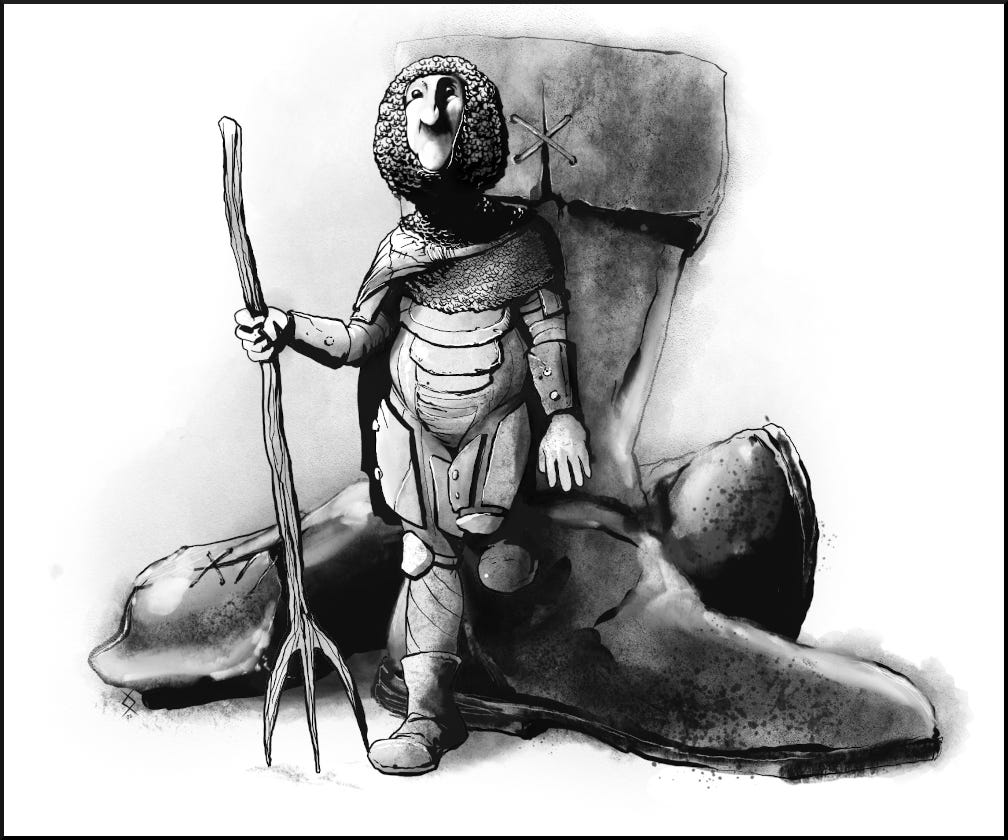
One of the best parts of joining Substack has been connecting with the community—which included working with Angeline Trevena (cartography) and Odinson (illustrations) as part of creating Bolted to the Bone; the image of Cadmus above is part of Odinson’s work found throughout the book.
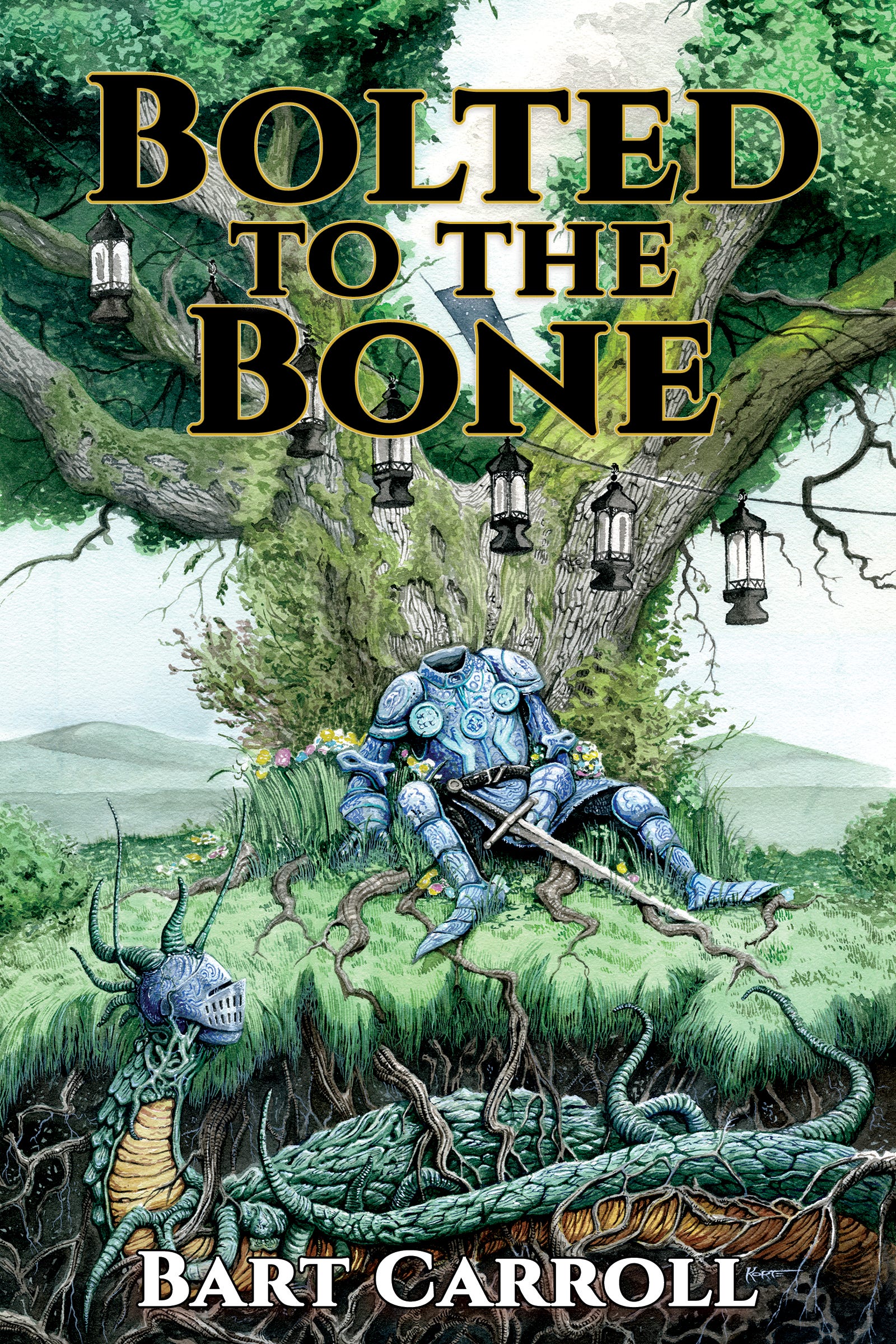
You can find Bolted to the Bone available now in paperback and ebook formats. Look for it at Amazon, Barnes & Noble, or other sellers of your choice!
4.3 stars on Goodreads. Reviews are always welcome!